

At How2Mom, we believe every family deserves to feel informed, supported, and confident as they prepare for birth. While we love to share natural comfort measures, we also know that medical pain relief can play an important role in many birth experiences.
Our goal here isn’t to sway you one way or another. It’s to give you clear, straightforward information—so you can make the choice that’s right for you and your baby.
Let’s break down the most common pain relief options for labor, one by one.
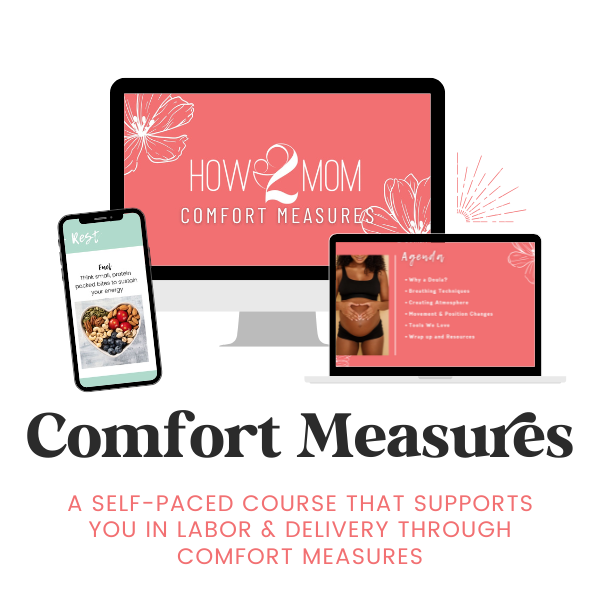
Want a complete picture to help you prep for labor? Check out our Comfort Measures for Labor Class! How2Mom Clients get 50% off.
1. Nitrous Oxide for Labor
Quick and easy to use, nitrous oxide (often called “laughing gas”) can be started or stopped at any time. It doesn’t affect the progress of labor, and you remain awake and able to move.
Pros: Helps with anxiety, fast-acting, no long-term side effects.
Cons: Some moms dislike the dizzy or “loopy” feeling, and nausea can happen.
The gas clears from your body within a few breaths, making it one of the least invasive medical options.
2. Analgesic Options
Analgesics are medications that lessen the intensity of contractions without causing total numbness. You remain awake and can move, though pain is not completely gone.
Pros: Keeps you alert, may take the edge off pain.
Cons: Possible drowsiness, nausea, or vomiting. This method also may not be available at certain times of labor. It has also been studied that these drugs can pass from your bloodstream through the placenta to the baby and can cause the baby to be drowsy.
3. Local Block
This option involves an injection of numbing medication in the perineal area, usually given right before birth or repair.
Pros: Keeps you awake and provides relief for stitches.
Cons: Doesn’t help with contractions, limited in scope.
Effect on baby: None known.
4. Epidural (Regional Block)
This is easily the most discussed form of medicated labor comfort. It usually provides total pain relief to the lower half of the body and can be used for vaginal birth or cesarean births. It allows mom to be awake and alert throughout labor and birth. The total relief of pain means that mom is able to rest if labor is long. The set up procedure itself takes about 10-20 minutes and usually another 10 to 20 minutes for the anesthetic to take effect.
Pros: Strongest pain relief option; allows you to rest during long labors; keeps you awake and alert.
Cons: Can lengthen labor, lower blood pressure, and limit mobility. Continuous monitoring is required.
Effect on baby: Usually none, but if your blood pressure drops, it may affect your baby’s heartbeat.
Ease labor pains with our comfort measures class!
Hey, expecting parents!
Are you looking for natural ways to manage labor discomfort? Then explore our Comfort Measures class for:
- Hands-on learning: Practice various comfort measures in a supportive environment.
- Expert guidance: Learn from experienced professionals dedicated to your well-being.
- Empowerment: Gain confidence in your ability to manage labor naturally.
Take control of your birth experience and discover effective comfort techniques. Sign up for our comfort measures for labor class today!
5. Spinal Block
Often used for scheduled c-sections, a spinal block involves a one-time injection into the back (no catheter). It provides immediate and full relief.
Pros: Quick, effective, reliable for surgical births.
Cons: Not suitable for ongoing labor, only used for surgery.
6. TAP Block
A TAP (Transversus Abdominis Plane) block is usually offered after a c-section. It numbs the abdominal wall to provide post-surgical pain relief.
Pros: Helps with recovery after surgery, reduces the need for systemic pain medications.
Cons: Only applicable for surgical births.
7. General Anesthesia
An IV is administered with drugs to make the mom drowsy, which is followed by the administration of a gas that is inhaled through a mask or breathing tube, causing mom to lose consciousness. This is only administered at the time of birth. It can be administered quickly, so it’s beneficial if any unforeseen complications arise.
Pros: Fast, effective in urgent situations. No pain.
Cons: You won’t be awake for the birth; nausea and vomiting are common afterward. The drugs used pass quickly through the mother’s bloodstream, through the placenta to the baby, so the baby may become drowsy and require help breathing after birth.

Final Thoughts from How2Mom
Every birth is unique. Some families prefer to try non-medical comfort measures first, while others know from the start that they want medication. What matters most is that you feel informed and supported. Want to dive deeper? The American College of Obstetricians and Gynecologists (ACOG) has an FAQ page we’ve linked just click on the name.
At How2Mom, we walk alongside you—helping you explore options, ask the right questions, and advocate for your preferences in the delivery room. Whether you choose breathing techniques, counter pressure, an epidural, or all of the above, we’re here to support your journey.
Thinking about building your birth team? Reach out to learn how a doula can make a difference in your experience.
Other Birthing Resources:
- 13 Comfort Measures for Birth
- 10 Medical Terms Every Pregnant Woman Should Know – For Labor – How2Mom | Birth Support, Online Birthing Classes, Resources for New Moms
- 10 Easy Snacks for Labor – How2Mom | Birth Support, Online Birthing Classes, Resources for New Moms
- Natural Ways to Induce Labor – How2Mom | Birth Support, Online Birthing Classes, Resources for New Moms
- Comfort Measures for Labor Class – Reduce your Labor Pains!
Pin this Blog!
*Medical Disclaimer: All content and information is for informational and educational purposes only. It does not constitute medical advice and does not establish any kind of client relationship. Although we strive to provide accurate general information, the information presented here is not a substitute for any kind of professional advice, and you should not rely solely on this information. Seek advice from your medical professional.
Any/all of the links in this blog may be affiliate links of which How 2 Mom, LLC receives a small commission, without any additional cost to you. Using affiliate links help us maintain our website, continue to provide for our community, and support our families, and we are forever grateful for your support!